
Rackslab announces the release of Slurm-web v6.1.0, a small update focused on practical improvements: enhanced core allocation visuals in the resources page, broader installation and deployment documentation for SLES and related distributions, and a comprehensive set of dependency and security fixes.
Slurm is the world leading workload manager for HPC clusters with all most advanced features to manage jobs and resources efficiently with a powerful command-line interface (CLI).
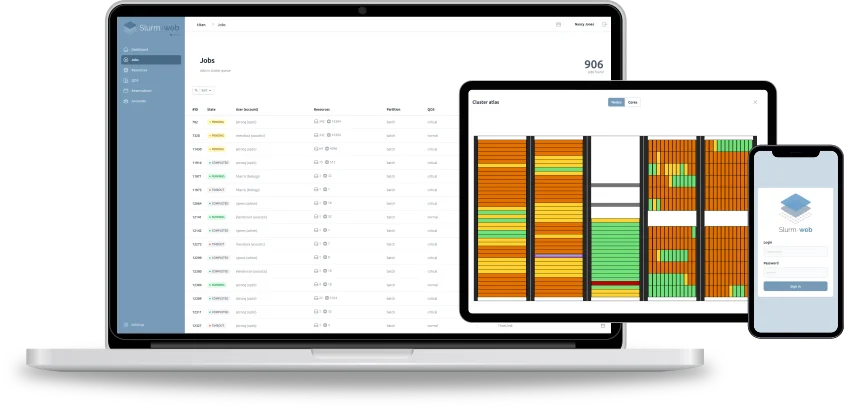
Slurm-web provides a clear graphical user interface with views to track your jobs, intuitive insights and advanced visualizations on top of Slurm to monitor status of HPC supercomputers in your organization, in a web browser on all your devices.
What’s New?
- Cores allocation visualization in resources page (#712)
The frontend now offers a thumbnailed graphical representation of core allocations in the resources page, making resource distribution easier to understand at a glance.
- Optional RacksDB lazy loading in agent (#683)
The agent now loads the RacksDB library lazily and only when enabled in configuration, reducing unnecessary dependencies for deployments that do not use RacksDB.
- Broader enterprise Linux platform and deployment guidance
Documentation now includes full install and upgrade procedures for SLES (and openSUSE Leap) environments, production HTTP server setup examples (apache2, nginx, caddy), and explicit support notes for RHEL 10 compatibles and Fedora 43 (#684, #653, #662).
- Dependency and security hardening across the front-end stack
Frontend dependencies were updated to address multiple published
vulnerabilities, including:
CVE-2025-13465, CVE-2026-2950, CVE-2026-4800 (lodash),
CVE-2025-62718, CVE-2026-25639, CVE-2026-42033 (axios),
CVE-2026-27606 (rollup), CVE-2026-27903, CVE-2026-27904,
CVE-2026-26996 (minimatch), CVE-2026-32141, CVE-2026-33228 (flatted),
CVE-2026-33671, CVE-2026-33672 (picomatch), CVE-2026-39363 (vite),
GHSA-r4q5-vmmm-2653 (follow-redirects), and CVE-2026-41305 (postcss).
- CLI and dependency-loading reliability improvements
Module imports have been refined so agent and gateway specific dependencies
remain better isolated during CLI argument setup
(#690), and a ClusterShell
NodeSet import issue in the agent has been fixed
(#682).
- Documentation quality and lifecycle updates
Minor documentation quality fixes were applied (including grammar and configuration/service naming corrections), and support mention for Fedora 41 has been removed as part of normal platform lifecycle maintenance.
Final Notes
We warmly thank NVIDIA and Zuse Institute Berlin (ZIB) for their contributions to this release.
This is a smaller release, and we want to share a bit of context with you. Over the past few months, part of our energy has gone into building a better and fairer business model around Slurm-web. The objective is simple: make development more sustainable, grow the team, and deliver improvements faster, while staying fully true to the project’s open source spirit. We will share more very soon, and we are grateful to have you with us on this journey.
We are now fully committed to the next major release, Slurm-web 7.0.0, planned for the coming weeks, with many new features on the way.